London’s full of event production companies. A quick search will return dozens of suppliers, all promising seamless delivery, state-of-the-art kit, and teams who are going to treat your event like their own.
Some will deliver on their promises, while others will turn up, set up their gear (often unsafely), and leave your team to manage whatever comes next.
Knowing how to tell the difference before you sign anything will save you. This guide is designed to help you make that call with confidence, whether you’re planning a flagship conference, an investor meeting, or a last-minute corporate event that still has to look world-class.
Who Should Read This?
- Marketing and communications managers briefing an event production partner for the first time
- EAs and operations leads responsible for delivering conferences, awards evenings, or investor days
- In-house event teams comparing full-service event production companies against AV hire-only options
- Anyone who’s been let down by a production supplier before and wants to avoid a repeat
Why It’s Worth Reading
- Choosing the wrong event production company in London doesn’t just affect your event, it affects your reputation
- The difference between AV hire and full production is widely misunderstood, and the wrong choice costs you time and money
- Knowing the right questions to ask separates reliable partners from box-shifters
What You’ll Learn
- The difference between audio visual hire in London and end-to-end event production
- What questions to ask any event production company before you commit
- Why venue knowledge is one of the most underrated factors in production quality
- What accountability should look like from a production partner
- How Beagle Create approaches the above, backed up by real examples
AV Hire vs. Event Production: What’s the Difference?
This is the question most event planners don’t figure out until it’s too late.
Audio visual hire in London means exactly what it sounds like: a supplier provides you with equipment (like LED screens, speakers, lighting rigs, microphones) and either drops it off to the venue or sets it up. What happens during the event is largely down to you.
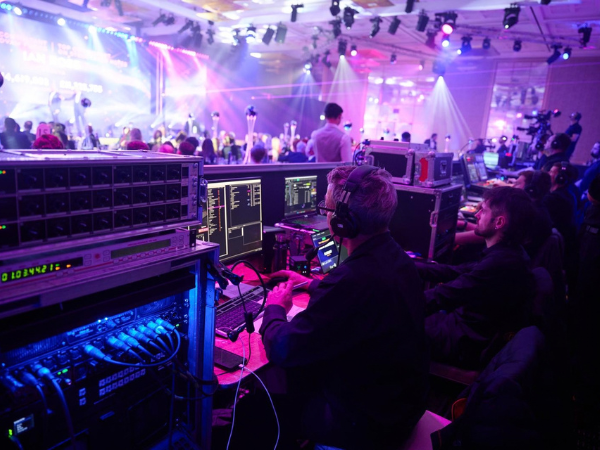
Full event production is different. A production company doesn’t just provide the kit; they plan technical delivery, manage the logistics, operate the equipment on the day, and take ownership of the event from load-in to de-rig. If something goes wrong, they fix it without you ever having to know it nearly went sideways.
For smaller, lower-stakes events, AV hire may be entirely sufficient. But for larger events like conferences, investor days, awards ceremonies, and product launches, the distinction matters enormously.
The right question to ask a supplier isn’t “What kit can you provide?” It’s “What’s gonna happen on the day, and who’s responsible when it doesn’t go to plan?”
Questions to Ask Any Event Production Company in London
Before you shortlist any event production company, run through the following questions:
1. Do you know the venue?
Venue knowledge is one of the most underrated factors in a smooth event. A production company that has worked in a given space before understands the power supply setup, the rigging points, the natural light, the acoustics, the loading bay restrictions, and the quirks that you can’t find in the venue brochure. That knowledge translates directly into faster builds, fewer surprises, and better outcomes.
2. Can you handle last-minute changes?
Events change. Briefs shift. Guest numbers move. Technical requirements evolve between the first conversation and delivery day. A capable event production company will absorb those challenges without drama. Ask them for an example of a time that something changed late and how they handled it.
3. Who’s on-site on the day?
This is non-negotiable. Confirm that the people running your event are the same people who planned it, or at a minimum, a senior technical lead who is fully briefed. Some companies quote one team and deliver another. The handover between planning and execution is where things go wrong.
4. How do you define “on budget”?
A trustworthy event production company will give you a clear, honest quote upfront and tell you immediately if scope changes affect cost. Be cautious of suppliers who give a low headline figure and add costs later. Ask specifically: what could cause this quote to increase?
5. Can I speak to a previous client?
Any reputable event production company should be able to point you towards a previous client who will vouch for them. Don’t just read a polished case study, have a real conversation with someone who has worked with them under pressure.
Why Venue Knowledge Changes Everything
There is a meaningful difference between a production company that has worked at a venue once and one that has an established relationship with a venue.
Beagle Create is the preferred AV and event production supplier at The Grove in Hertfordshire, one of the UK’s most prestigious five-star conference and events venues. That relationship exists because we have delivered, consistently, across a wide range of event types in the space.
When a client came to us needing a high-impact visual solution for a conference in the Cedar Suite at The Grove, we had under one week from brief to delivery. The Cedar Suite is a beautiful space, with floor-to-ceiling glass and plenty of natural light, a setting that works against standard projection setups. We installed a 9-metre wide 2.6mm pitch high-brightness LED screen specifically engineered to perform in naturally lit environments. Crystal-clear visuals, perfect sightlines for every delegate, delivered on time and on budget.
That turnaround was only possible because we know the Cedar Suite’s layout, power infrastructure, and logistics inside out. A production company encountering the space for the first time would not have moved at that speed without cutting corners somewhere.
We also deliver the annual investor meetings at The Grove. These are high-stakes conference productions where precision, confidentiality, and a consistent standard of delivery are non-negotiable. Venue familiarity makes that possible. It also makes the day calmer for everyone involved.
What Accountability Looks Like
Most event production companies will tell you they are reliable. Fewer of them will tell you what they’ll do if something goes wrong.
Real accountability means a named point of contact from brief to delivery. It means a technical team that has rehearsed the event, not just set it up. It means a supplier who tells you about potential risks before the day, not after something has already happened.
It also means budget honesty. An event production company that respects your budget will tell you what is and isn’t achievable within it and will find solutions rather than adding cost.
At Beagle Create, we operate on a simple principle: your event is our event. That means we do not treat production as a service we hand back at the end of the day. We treat it as something we are responsible for. The outcome of your event reflects on us, which means we have every reason to make sure it goes well.
How to Evaluate Event Production Companies Against Each Other
When you are comparing event production companies in London, resist the temptation to make equipment the primary measure. Most reputable suppliers have access to comparable kit. The key differentiators are:
- People. Who’s going to be there on the day, and what’s their experience level?
- Process. How do they manage the brief, the build, and the unexpected?
- Proof. Who have they delivered for, under what conditions, and what do those clients say?
- Partnership. Do they feel like an extension of your team, or a supplier you have to manage?
- Presence. Are they a recommended or preferred supplier at your venue, or starting from scratch?
Price matters, of course. But a slightly higher fee from a company with venue knowledge, a proven track record, and genuine accountability for outcomes is almost always better value than the lowest quote on the table.
A Final Note on Audio Visual Hire in London
Audio visual hire in London is a broad category. At one end, you have equipment-only suppliers who will deliver gear, show you how to operate it, and wish you luck. At the other, you have full-service event production companies (like Beagle Create) who will design the technical solution, install it, operate it throughout the event, and be responsible for everything that happens.
Both have their place. But if you want your event to be the best it can be, you want a production partner.
The distinction is simple: AV hire provides the tools. Event production provides the result.
Working on an event in London?
Whether you need audio visual hire for a straightforward corporate meeting or a full-service event production company for a flagship conference, Beagle Create delivers the right solution, properly planned, expertly executed, and on budget.
Get in touch at info@beaglecreate.com or call +44 (0) 1767 686 219. We’re ready when you are.